LPL Financial 2026 Midyear Outlook: The Market Observatory [Video]


Midterm elections. A change of leadership at the Fed. The shifting AI theme. There's a lot for investors to think about as we move into the second half of the year. To help navigate the path ahead for markets and the economy, Sam and I welcomed a special guest to this month's Market Observatory, Marc Zabicki, LPL's chief investment officer.
Our wide-ranging conversation covers what investors should be watching for the rest of the year, what to expect from a Kevin Warsh-led Fed, AI risks and opportunities, and much more. Watch the video for the full story:
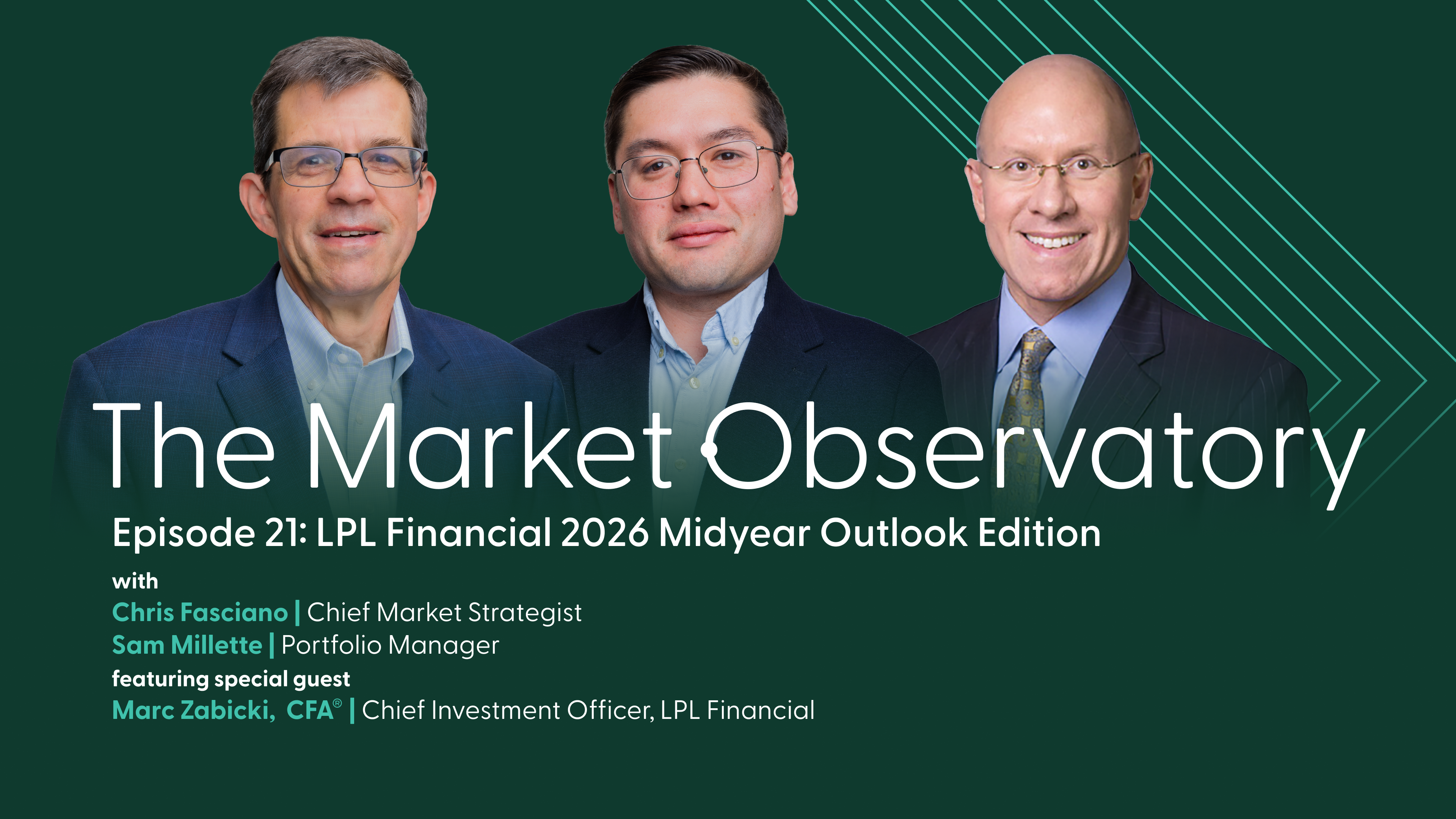
LPL Financial 2026 Midyear Outlook: The Market Observatory [Video]
Duration:
Sam
Well, Chris, we’re halfway through the year. It’s hard to believe it, but what a year it’s been so far for investors. Whether it be the conflict in Iran, the new head of the Fed, or the shifting theme in AI, there’s been plenty for markets and investors to navigate.
Chris
There has certainly been a lot to talk about, Sam. And it’s left investors wondering what to expect as we look forward to the second half of 2026. And that’s what the focus of this special Midyear Outlook episode of the Market Observatory is all about. Today, we are excited to welcome LPL Financial’s chief investment officer, Marc Zabicki. Mark guides LPL’s overall investment decision-making process and has joined us today to talk through LPL’s 2026 Midyear Outlook. Welcome back to the Market Observatory, Marc.
Marc
Many thanks there, Chris and Sam. Good to see you.
Chris
So let’s dive right in. Policy headlines have driven market volatility over the last 18 months. Tariffs, the budget bill negotiations, and the war in the Middle East have all unnerved investors at some point. But ultimately, phenomenal earnings growth has driven markets higher and higher. And where we sit today, that’s probably the backdrop that’s going to continue.
Chris
So, historically, midterm elections have driven volatility due to all the uncertainty. And with the House and the Senate hanging in the balance, I’m guessing this year will be the same. But, as Election Day approaches and that uncertainty begins to dissipate, markets do tend to act better. And the policy implications of the election will be a bigger issue for investors next year when the new Congress is seated.
Chris
So, from my perspective, the two biggest things that investors need to be focused on for the remainder of this year is the AI story, and how it impacts earnings growth, and a Kevin Warsh Fed. So, let’s start with the Fed, Marc. Investors interpreted Warsh’s first press conference as hawkish. And I’m wondering, how much of future Fed policy is going to be driven by the war in the Middle East and the full reopening of the Strait of Hormuz?
Marc
Yeah, quite a bit of it, Chris. And as the certainty just kind of still continues to play out in the Middle East and the Iran-U.S. conflict continues to play out, I mean, that’s going to stall the way the Federal Reserve thinks about what they previously thought about ahead of the Kevin Warsh seating is, are we going to eventually get an easing in interest rate policy at some point? So, we think we probably would have seen kind of a path toward more easing, absent the Iran conflict. Clearly, the Iran conflict is, has made the Federal Reserve kind of slow down its thought process. Now the market is pricing in a small chance of maybe a rate hike. We don’t think that’s going to happen, but I think it’s going to make the Federal Reserve conversation a little bit more of a confusing one throughout the back half of the year. I mean, from my perspective, I think they should definitely not raise interest rates here because, historically, when the Federal Reserve looks at the movement in oil prices, they typically consider it short term. I don’t know why they would think about it differently now. And then I think Kevin Warsh is probably going to be building in some expectation around what AI is going to do to overall productivity, and what technology, the proliferation of technology and the utilization of technology here in the U.S., is frankly going to do to just overall productivity and perhaps a disinflationary impact. So long-winded answer, but I think, I think when we sit here in six months from now, I still think we’re probably going to be trying to figure out where the Federal Reserve is going with policy.
Sam
Yeah, to add another layer to it though, Marc. You know, we do have a change in leadership at the Fed. And one of the things that was pretty prominent in Chair Warsh’s first press conference as chair was the announcement of five different task forces that are going to be used to kind of reshape how the Fed views some key policies. Can you speak a little bit to that, and what some of the kind of key things to watch for are for investors when it comes to changes at the Fed?
Marc
Yeah, I mean, I think the task forces, Sam, were probably put in place to really modernize maybe the Fed’s thinking a little bit about monetary policy. I personally believe the Federal Reserve is a little bit too backward-looking, and what I’ve read from Kevin Warsh, I think he wants the Federal Reserve to be a little bit more forward-looking. So I’m personally hoping that some of these task forces push the Federal Reserve in that regard. I know there’s some questions about how much visibility that he wants to give in terms of future Fed policy. I’m sure there’ll be some decisions made around that as well. You know, my expectation, whether it’s task force related or the way he massages the thought process of other board members, is that, you know, he’s a big believer that productivity is actually going to be higher in the next several years, driven by technology overall, driven by AI. I think that’s going to start really bleeding into some, some policy decisions and thought processes.
Chris
Let’s pivot to AI. It has been the dominant theme in the market now for some time, and investors have certainly responded to it. And now we have several big IPOs coming that are pure plays on the theme to compete for investor capital. What do you see as the biggest risk to businesses from AI currently?
Marc
Yeah, I tell you, Chris, this wouldn’t be a market strategy conversation if we didn’t talk about AI. So the clearly the biggest risk, and I think we all know this, it’s, it’s what the trajectory of the build-out is going to be, because there’s been so much expectation about a certain level of a build-out that, that we’re expected to see over the next several years and trillion dollars being spent to that end. To the degree that expectations change and maybe the build-out is less than expected based on you know the, the lack of a realization of return on investment. So I think you know 20-, the latter half of 2026 and into 2027, I think we’re going to see players get more serious about return on investment, which may lead them to second guess some build-out expectations. That itself is probably the biggest risk facing the market, because valuations, while not overly uncomfortably high, they are indeed high, and there’s been a lot of momentum built up in this whole AI story. A change in expectations just could take some air out of the balloon.
Sam
So, it sounds like there’s some potential headwinds, but a lot of uncertainty here when it comes to forecasts. What do you think investors specifically should be looking at as they try to navigate the AI theme throughout the next couple of months?
Marc
Yeah, it’s really about those expectations, Sam. It’s about, it’s about the valuations that you’re, you’re paying for those, those future cash flows. We look at, we’ve been looking at the amount of momentum that’s built into this market. Momentum is clearly the leading factor that’s, that’s moving this market. In addition to what Chris mentioned, earnings fundamentally have also been good, so we can’t discount that, but this market can move on a dime. So, if there are changes to expectations, if we do get some sense that earnings aren’t going to be quite what the market is forecasting or people expect, then, then I think some air could come out of the balloon. Secondarily, I think it’s really policy related, you know. Chris alluded to at the top, is like, you know, people are going to start getting nervous as we get into the November elections. It always typically happens, you can nearly set your watch by it. And we’re expecting some level of change in the balance of power in Congress. When we start getting closer to those conversations around November, I think we’re going to also see some, some volatility. So we use the word volatility a lot, and, but I, and it’s been volatile so far this year. I don’t know that that changes much in the back half.
Chris
So let’s talk a little bit about earnings. I’m a big believer that over the long term, fundamentals do drive markets. And we have seen S&P 500 earnings estimates for both 2026 and 2027 move up considerably. That’s been really good for investors, but it also raises the bar and sets up the potential for disappointment. So, I’m wondering, from your perspective, is there enough earnings momentum outside of AI that if we see any softness in the AI fundamentals, that corporate America can still deliver on that earnings growth that’s expected right now.
Marc
Yeah, Chris, so let’s set AI aside for a minute. I mean, just look at things from a kind of an economic fundamental view, and really the biggest pieces of the puzzle from a, from a GDP perspective, which we expect to be a driver of earnings, is really consumer spending, business spending. As we look at both of those buckets, the consumer remains in relatively good standing in aggregate. I think we could probably all three agree that there is a K-shaped economy going on. There is a definitive wealth effect that I think we all three can see as well. That alone is probably making the consumer feel a little bit more comfortable. The upper portion of the K is looking at their stock prices, looking at their home price in general, and saying, well, I feel pretty good, I can go out and spend some money. And that, so far, has been the case. So, we expect the consumer to continue to remain relatively strong. Their balance sheets are in pretty good order. Unemployment we don’t see is going to be a problem. We are indeed expecting it to tick higher from here, but not materially higher to the degree that would upset consumer spending. From a business spending perspective, we think manufacturing activity is probably stronger than I would have expected. Services-based activity also continues to be strong as people like Sam go out to dinner and stay at hotels around the United States of America. So from a, from an economic, pure economic perspective, we’ve got the building blocks that are going to drive earnings, so if we set that aside, I think that is a good foundation on which to build.
Chris
And it’s interesting. Despite all the excitement about AI and IPOs and growth, this year has really been a stealth testament to diversification. Values outperform growth, small-caps outperform large-cap. International has continued to outperform. My view is that is likely to continue as we move forward over the rest of the year. But what’s the best advice you can give clients as to how to position the equity portion of a portfolio currently to navigate what we’ve been talking about.
Marc
Yeah, I think Chris, it’s a timely question. We’ve actually at LPL reduced some beta exposures, at least suggested to our clients reducing some beta exposure in the portfolio as a, as a theme that we’ve incorporated. We’ve suggested like low volatility exposure, which indeed is not technology exposure. We actually reduced our technology position from overweight to equal weight, so we’ve taken some logs off the fire there. You’ve already addressed some of those reasons. One of them is the upcoming election, the other is some uncertainty around Federal Reserve policy, et cetera, but I think as an investor you’ve got to be thinking about risk management here. You’ve got to be thinking about diversification in a market where momentum is moving a lot of equity prices back and forth. And in an environment when you’ve got increased levels of risk and lack of visibility, I mean, if you’re driving your car in some fog, you lack visibility. What do you do? You slow down, and we’re slowing down the risk levels that we’re adding to equity portfolios through the back half of 2026 because we think that’s prudent.
Sam
Yeah, Marc, it sounds like you guys are really dialing back on the risk levels in the equity allocations. Are you making similar recommendations for fixed income or is it a little bit different? Just sort of, what’s your view on fixed income’s position in a diversified portfolio?
Marc
I’ll tell you, Sam, at the risk of sounding boring, we indeed are. I mean, we’ve, we’ve, and we’ve, we’ve been this way for quite some time in terms of the way we think about core bond exposure versus non-core exposure or spread exposure. So we haven’t been an advocate for high-yield bond exposure, EM debt, and the like for quite some time, thinking that you’re not getting paid for the risk that you’re taking in those segments. So again, at the risk of being boring, Treasuries, mortgage-backed securities, and investment-grade corporate bonds, the core segments of the bond market are indeed the place to be. The concept, in terms of interest rate expectations, are that we think the 10-year Treasury yield is going to be landing at the end of the year between maybe 4 and 450, so there’s probably not a whole lot of upside in bonds, but you are getting a pretty decent carry. And that carry is somewhat competitive versus what we think the equity market is going to give you through the back half of the year so.
Sam
Yeah, completely agree. And I would say I do think boring is a good word when it comes to bonds. So, happy to hear that. Moving on a little bit to an asset class that sometimes isn’t as boring, can you speak a little bit to kind of the role of alternatives in a portfolio? Do you see them as being useful as a diversifier?
Marc
So correlations post-Covid between stocks and bonds have been positive. And you, in the 20 years prior to Covid, you didn’t see that. And when correlations between stocks and bonds are positive, the levels of a diversification of a multi-asset portfolio degenerate just a little bit. And our answer to that, and what we’ve been delivering to our audiences is is you have to add another asset class to add more diversification properties to a multi-asset portfolio. To us, that means alternatives is one of those options. Clearly, that doesn’t mean private credit or private equity, both of those are correlated to their own respective public markets. To us, it does mean global macro managers, means long short managers, and also means managed futures managers. Why? Because those managers typically give you exposure that’s non-correlated to public markets. It is actually going to give you a little bit more of a portfolio that may zig when the market zags, and obviously, from a diversification standpoint, that is indeed important.
Sam
Yeah, I certainly agree, Marc. Well, thank you so much for joining us today and sharing your thoughts with our viewers.
Marc
Oh, you’re very welcome, Sam and Chris. Good to see you both.
Sam
And thank you for joining us. Join us again next month for another update from the Market Observatory. And in the meantime, please check out the 2026 Midyear Outlook by the LPL Research team for further insights into the key themes throughout the rest of the year. Certain sections of this commentary contain forward-looking statements as of the date published that are based on our reasonable expectations, estimates, projections, and assumptions. Forward-looking statements are not guarantees of future performance and involve certain risks and uncertainties, which are difficult to predict. Opinions are subject to change without notice. This communication should not be construed as investment advice, nor as a solicitation or recommendation to buy or sell any security or investment product. Investing in alternative investments may not be suitable for all investors and involves special risks, such as risk associated with leveraging the investment, utilizing complex financial derivatives, adverse market forces, regulatory and tax code changes, and illiquidity. There is no assurance that the investment objective will be attained.
For more insights on the key themes that will drive markets in the months ahead, check out the LPL 2026 Midyear Outlook.
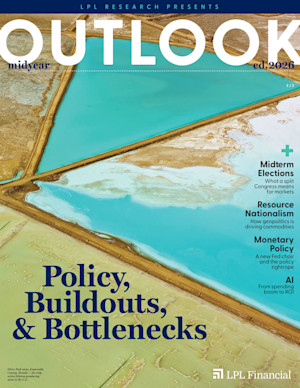
LPL RESEARCH PRESENTS
2026 Midyear Outlook: Policy, Buildouts, & Bottlenecks
Get insights and analysis on the key themes driving markets in the second half of the year.

The information on this website is intended for informational/educational purposes only and should not be construed as investment advice, a solicitation, or a recommendation to buy or sell any security or investment product. Please contact your financial professional for more information specific to your situation.
Certain sections of this commentary contain forward-looking statements that are based on our reasonable expectations, estimates, projections, and assumptions. Forward-looking statements are not guarantees of future performance and involve certain risks and uncertainties, which are difficult to predict. Past performance is not indicative of future results. Diversification does not assure a profit or protect against loss in declining markets.
The S&P 500 Index is a broad-based measurement of changes in stock market conditions based on the average performance of 500 widely held common stocks. All indices are unmanaged and investors cannot invest directly into an index.
The MSCI EAFE (Europe, Australasia, Far East) Index is a free float‐adjusted market capitalization index that is designed to measure the equity market performance of developed markets, excluding the U.S. and Canada. The MSCI EAFE Index consists of 21 developed market country indices.
Third-party links are provided to you as a courtesy. We make no representation as to the completeness or accuracy of information provided at these websites. Information on such sites, including third-party links contained within, should not be construed as an endorsement or adoption by Commonwealth of any kind. You should consult with a financial advisor regarding your specific situation.
Please review our Terms of Use.